


Castles of Mad King Ludwig
4.4209.00 Reviews
App Specs
- Version
- 2.1.4
- Updated On
- License
- $7.99
- Downloads
- 10,000+
- Developer
- Bezier Games
- Categories
- Board
- Platform
- Android
Screenshots
 Analysis by AppCompare
I approached Castles of Mad King Ludwig as a digital board game rather than as a quick casual diversion. Its central idea is appealing: I build a castle room by room, while trying to make sensible connections and decisions that improve the whole design. The app is based on the board game from Bezier Games, and it keeps the focus on planning, placement, and the slightly strange pleasure of turning separate rooms into a functioning royal residence.
That focus makes it a particularly interesting choice for people who enjoy board games but do not always have a physical table, a willing group, or enough time to set up a full box of components. I found it most rewarding when I treated each turn as a small architectural puzzle instead of rushing toward the most impressive-looking room. The game asks me to balance immediate gains with the shape of the castle I am building, and that tension gives it more depth than the friendly theme initially suggests.
How the digital castle works for different players
I look at how the castle’s room-by-room layout asks different players to balance immediate rewards against the shape of the whole build. That distinction helps explain why the same turn can feel inviting to a patient strategist and demanding to someone seeking a casual break. Next, I’ll consider how that shared visual puzzle affects comfort and accessibility in everyday play.
Readability, navigation, and the effort of understanding a turn
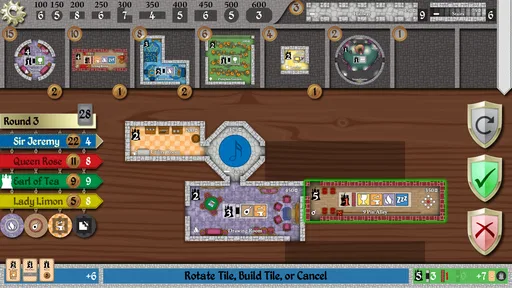
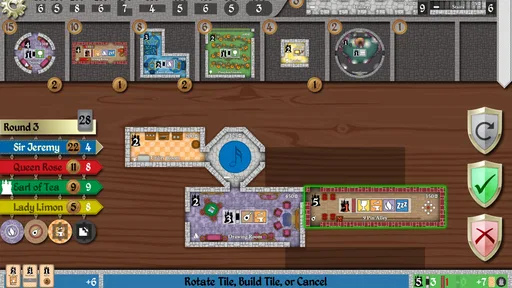
The first important question for any digital board game is whether I can tell what is happening without constantly stopping to decode the interface. Here, the castle itself is the main visual reference. Rooms, connections, and available choices need to be read together, so the experience rewards a calm pace and attention to the board rather than rapid tapping.
I would not describe the presentation as something to skim casually. A new player has to learn what each part of the castle means, which options are useful now, and which choices may matter later. That learning curve is not necessarily a flaw, because it is part of the board-game character, but it does mean that the first session is better approached as practice. I recommend taking time to inspect the available room choices before committing, especially when a placement could affect several future decisions.
Navigation is most comfortable when I keep a clear mental routine: check the rooms on offer, consider how each one connects to the existing castle, look at the immediate reward, and then think about the longer-term shape. That routine reduces the feeling of being overwhelmed by the board. It also helps players who prefer predictable sequences, because each turn can be broken into recognizable steps instead of treated as one large decision.
The game’s visual information is closely tied to the board, so players who have difficulty distinguishing small details may need a larger screen or a more deliberate pace. I would avoid assuming that a phone display will feel equally comfortable for everyone. On a compact device, the castle can demand more inspection, while a larger tablet-style screen gives the layout more breathing room. The game remains fundamentally understandable, but the physical device affects how easily I can compare distant parts of the castle.
Worth Reading Before You Choose

EA SPORTS FC Mobile 26 Is a Bigger Football Game, but It Takes Time

Flipboard Shows What News Apps Must Do Beyond the Feed

Switching to Android Auto Means Rethinking Your Driving Routine

Google Calendar Makes a Crowded Week Easier to Manage

Ludo King Makes the Most of the Minutes Between Plans

Baby Panda World Brings Quick Play to Modern Phones, but Its Game Library Feels Busy
One useful habit is to pause before selecting a room and read the entire arrangement rather than focusing only on the most attractive option. A room that looks valuable by itself may create an awkward gap or restrict a better connection later. This is one of the less obvious strengths of the design: the app encourages visual scanning and spatial reasoning, not just recognition of the highest immediate reward.
For someone who has never played the tabletop version, the most approachable path is to begin with modest goals. I would first try to understand how rooms fit together and how the castle develops, then worry about playing efficiently. Trying to optimize every choice immediately can make the game feel more complicated than it is. Once the basic rhythm becomes familiar, the decisions feel more intentional and the interface becomes easier to read.
Motor and sensory considerations during play
From a motor perspective, this is a board game built around selecting and placing rather than fast action. That makes it naturally calmer than an arcade title or a real-time strategy game. I never felt that success depended on quick reflexes. The important actions are deliberate, and the main challenge comes from deciding where a room belongs and what its consequences might be.
That does not mean every player will find the controls equally effortless. Board-game interfaces often require accurate taps on particular rooms or controls, and a crowded layout can be more demanding for people with limited precision. I would play with the device resting on a stable surface if repeated holding or tapping becomes tiring. The slower pace also makes it practical to take breaks without losing the thread of the session.
Sensory comfort is more complicated because the game relies on visual information. The castle, room choices, and surrounding details all compete for attention, so players who are sensitive to dense screens may prefer a larger display and a quieter environment. I found that reducing distractions around me improved the experience more than trying to play while multitasking. This is not a game I would choose when I only have half an eye on the screen.
Players with color-vision differences should pay attention to whether room distinctions remain clear through their shapes, labels, and positions rather than relying on color alone. I would not build a strategy around color recognition without first checking that the visual information is comfortable for me. The safest approach is to use the room’s complete presentation and zoom or enlarge the device view when needed.
Audio is not the reason to play this title. The meaningful information is on the board, which is helpful for anyone who prefers a quiet game or cannot rely on sound. At the same time, the visual dependence means that players who need strong spoken guidance may find the experience less accommodating than a heavily narrated game. This is a good example of a trade-off: the absence of reflex-heavy play helps some people, while the board’s visual density may still challenge others.
I also appreciate that the game’s basic appeal does not depend on physical dexterity with cards, tokens, or tiles. A digital version removes the need to sort components, reach across a table, or maintain a shared physical layout. For players who find tabletop handling uncomfortable, that can be a meaningful advantage. The replacement is a screen-based interaction that still requires careful selection, so it solves some barriers rather than all of them.
Situational access: when the app fits everyday life
The best everyday use case I found was a quiet evening when I wanted something more thoughtful than a puzzle but less demanding than a long competitive game. I could open it, inspect the castle, and focus on one decision at a time without needing a group to coordinate. That makes it suitable for a solo player who enjoys board-game logic but often plays alone.
It can also work well for a shared session in which players take turns on one device, provided everyone is comfortable looking closely at the same screen. The digital format removes setup and cleanup, which is useful in a small living space or during travel. However, it does not automatically recreate the social ease of a physical board. Passing a phone around is less comfortable than sitting around a table, and a larger screen makes shared viewing much more practical.
For a commuter or someone with an unpredictable schedule, the turn-based structure is more forgiving than a game that demands uninterrupted attention. I can think through a placement instead of reacting immediately. Still, I would not start a session in a situation where I may need to respond instantly to another task. The game’s decisions deserve concentration, and losing focus can make the castle feel confusing even when the rules themselves are manageable.
The age rating is Everyone, which makes the theme broadly approachable for households looking for a non-violent board game. The unusual king and castle setting gives it personality without turning the experience into an action title. Parents or relatives playing with younger users should still expect to explain the strategic choices, because an everyone-friendly presentation does not mean every rule will be instantly obvious.
Compatibility also affects who can use it comfortably. The listed minimum operating system is Android 4.1, so it is positioned to support older Android devices. That is useful for people who do not replace phones frequently, although the age of a device can still affect screen comfort and general responsiveness. I would judge the experience not only by whether the app opens, but also by whether the display is large and clear enough for the castle layout.
The current version is 2.1.4, and the app has been available since May 23, 2016. Those details matter mainly as context: this is an established digital board game rather than a brand-new experiment. I would approach it with the expectations of a focused adaptation, not a constantly changing live-service game. Its value comes from the underlying design and the convenience of digital play, not from chasing frequent novelty.
Where the experience still creates barriers
The largest barrier is the amount of visual comparison required. I need to look at the room in front of me, the rooms already placed, and the possible consequences of connecting them. Someone who wants a simple game with one obvious action per turn may find this tiring. The castle-building theme is welcoming, but the decision-making underneath it is more demanding than a purely decorative building game.
Another limitation is that the digital format can make social play feel less natural. A physical board gives everyone a shared object to point at, discuss, and inspect from their own angle. On a phone, one player may control the screen while others wait for a view. If the main reason I want a board game is conversation and face-to-face interaction, a physical alternative may be the better purchase.
The game is also not ideal for players who dislike planning several steps ahead. I can make a perfectly valid move and still regret it later because the castle’s layout becomes less flexible. That is satisfying when I want strategy, but frustrating when I want a relaxing builder with no meaningful downside to experimentation. The distinction is important: this is a game about constructing a castle, not simply decorating one.
Screen size is another practical trade-off. On a small phone, I may need to inspect the board more carefully and tolerate a denser presentation. A larger device can improve comfort, but it is less pocket-friendly. I would choose the device based on how much visual detail I can comfortably track, not just on whether the operating system meets the requirement.
There is also a financial decision. The game costs $7.99, so it is not competing with free-to-start casual apps on price alone. I think that cost makes more sense for someone who already knows they enjoy strategic board games or who values a self-contained experience. A person looking only for a five-minute distraction may get better value from a simpler free game, while a regular tabletop player may find the convenience worthwhile.
The store audience is not tiny: it has more than 10 thousand installs, an average rating of 4.4 from around 1.1 thousand ratings, and 209 written reviews. I treat those figures as a useful sign that the app has found a real audience, not as a guarantee that it will suit every player. The more important question is whether I want thoughtful room placement and spatial planning, because those are the qualities that determine the fit.
Who should choose it, and who should look elsewhere
I would recommend it to players who like board games with visible consequences. Every room contributes to a larger structure, and the most satisfying moments come from recognizing that an earlier decision has created a useful opportunity. It is especially suitable for people who enjoy playing alone, prefer turn-based decisions, and want a game that can be revisited without requiring a full tabletop setup.
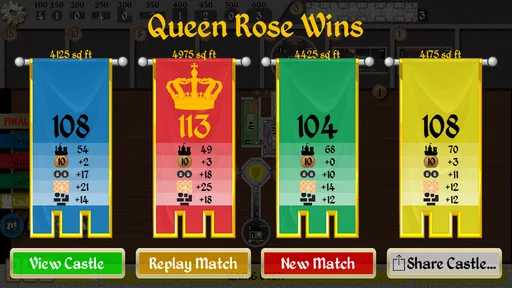
It is also a good choice for someone curious about modern board games but unsure about buying a physical box. The app offers a compact way to discover whether spatial planning and layered scoring appeal to me. I would still expect to learn through play rather than understand every strategic possibility immediately. The first few sessions are better used to observe patterns than to judge myself harshly for inefficient castles.
I would skip it if my priority is a fast, highly social party game. I would also look elsewhere if I want a purely creative building sandbox, because the game’s structure asks me to make strategic compromises. Players who need strong audio guidance, very sparse visual layouts, or minimal tapping should test their comfort carefully before committing to the purchase.
Compared with a traditional physical board game, this version wins on setup, portability, and the ability to play without storing or sorting components. The physical version wins on shared visibility, tactile feedback, and natural conversation around the table. Compared with casual mobile builders, this app offers more meaningful planning but less instant accessibility. Compared with action-oriented digital games, it is slower and more forgiving physically, yet more demanding in attention and visual reasoning.
My inclusive verdict after living with the design
What I like most is that the game’s challenge comes from choices rather than speed. That gives players time to think and makes it easier to fit a session around an ordinary routine. The castle grows in a way that feels personal, and the best decisions are rarely the loudest or most obvious ones. I found that rewarding because it turns careful observation into progress.
Its accessibility is therefore situational rather than universal. The calm, turn-based format and lack of dependence on rapid reflexes can support many players, while the visually dense board, small-screen demands, and need for spatial comparison can create real obstacles. I would choose a larger display, a stable playing position, and an unrushed setting whenever visual or motor comfort is a concern.
Bezier Games has made a focused board-game adaptation for people who want the logic of castle construction without the physical setup. The $7.99 price is easiest to justify when I know I will return to strategic tabletop-style play, and the established release history suggests a mature product rather than a novelty app. With its Everyone rating and support beginning at Android 4.1, it is broadly positioned, but personal comfort with the interface still matters more than the label.
My final recommendation is positive, with a clear condition: choose it for thoughtful castle planning, not for effortless decoration or lively group entertainment. If that distinction matches what you want, Castles of Mad King Ludwig offers a compact and distinctive way to play a serious board game on a mobile device. I would recommend it to a friend who enjoys making careful compromises, checking how separate pieces fit into a larger plan, and returning to a game because the next castle might turn out better than the last.
Pros
- Creative castle-building system with satisfying spatial puzzles.
- Strong visual theme and charming medieval artwork.
- Many scoring paths support different play styles.
- Works well for both casual and experienced board-game fans.
- Asynchronous play makes longer matches easy to manage.
Cons
- The rules can feel overwhelming during the first few games.
- Some matches may take longer than expected on mobile.
- Limited player interaction can make turns feel solitary.
- Random objectives may occasionally create uneven strategies.
- Small text and icons can be difficult to read on phones.
FAQs for Castles of Mad King Ludwig
What is Castles of Mad King Ludwig?
Castles of Mad King Ludwig is a digital adaptation of the strategic tile-laying board game in which players design extravagant castles for the eccentric King Ludwig. You purchase and place differently shaped rooms, connect them into a functioning palace, and earn points for completing objectives. The game combines planning, spatial puzzle-solving, resource management, and competition against other builders.
How does the gameplay work?
Each round, players take turns acting as the Master Builder, pricing rooms before everyone has an opportunity to purchase them. You must think carefully about room placement, connections, bonuses, and available money because an attractive room may still be a poor investment. Completing rooms and satisfying objectives can increase your score, while inefficient layouts or overly generous pricing may help your opponents.
Can Castles of Mad King Ludwig be played offline or without other players?
The game is designed to support solo play against computer-controlled opponents, making it possible to enjoy a full castle-building experience even when no friends are available. Depending on the version and platform features, multiplayer options may also be available for playing with other people. Check the store listing for the current online, local, and offline requirements before downloading.
Is Castles of Mad King Ludwig suitable for beginners?
It is approachable for players who enjoy board games and strategy, but it may take a few rounds to understand the scoring system, room interactions, and the unusual pricing mechanic. The tutorial and guided explanations are useful for learning the basics. Beginners should start with a lower difficulty level and focus on building efficient connections before attempting advanced scoring combinations.
Does the game include in-app purchases or require an internet connection?
The exact monetization and connection requirements can vary according to the Android or iOS release, so prospective players should review the current store description before installing. Some versions may offer paid content, optional purchases, advertisements, or premium access. An internet connection may be needed for downloading, updates, cloud features, or multiplayer, even if the main solo game works offline.


